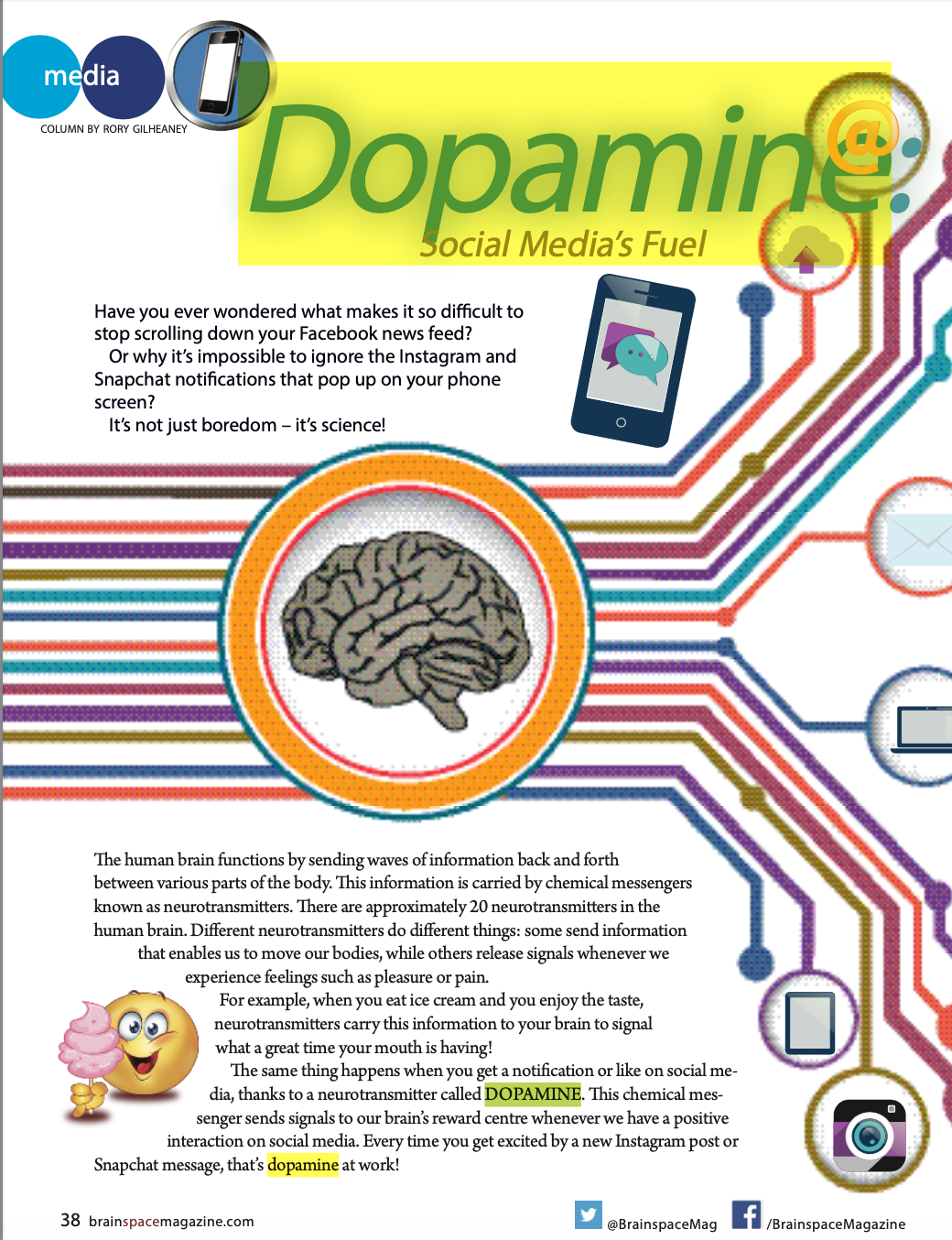
Have you ever wondered what makes it so difficult to stop scrolling down your Facebook news feed? Or why it’s impossible to ignore the Instagram and Snapchat notifications that pop up on your phone screen? It’s not just boredom – it’s science!
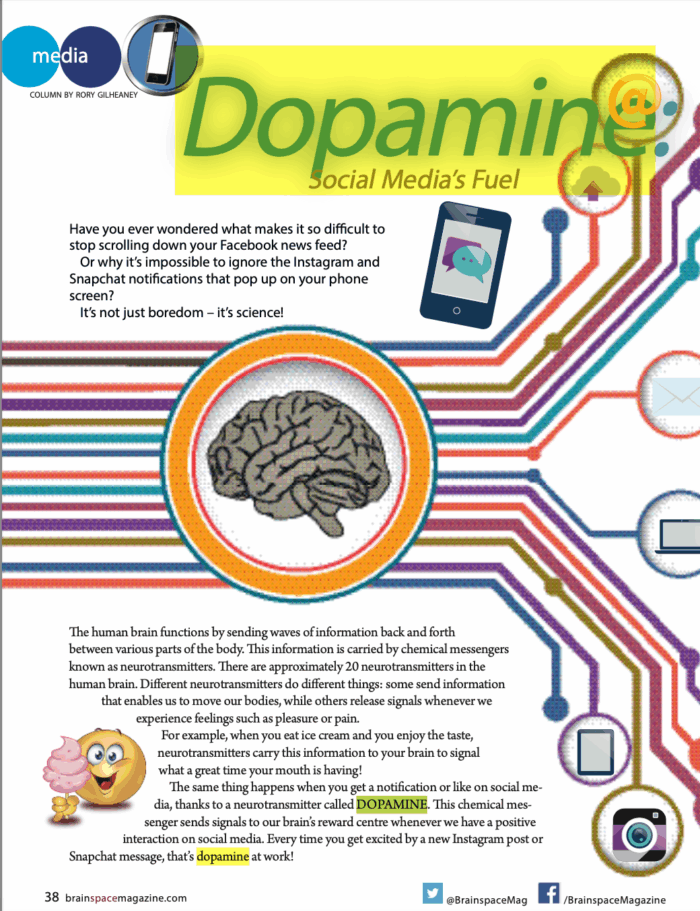
The human brain functions by sending waves of information back and forth between various parts of the body. This information is carried by chemical messengers known as neurotransmitters. There are approximately 20 neurotransmitters in the human brain. Different neurotransmitters do different things: some send information that enables us to move our bodies, while others release signals whenever we experience feelings such as pleasure or pain. For example, when you eat ice cream and you enjoy the taste, neurotransmitters carry this information to your brain to signal what a great time your mouth is having! The same thing happens when you get a notification or like on social media, thanks to a neurotransmitter called DOPAMINE. This chemical messenger sends signals to our brain’s reward centre whenever we have a positive interaction on social media. Every time you get excited by a new Instagram post or Snapchat message, that’s dopamine at work! Dr. Donald Weaver has studied the relationship between social media and the human brain for many years at the Krembil Research Institute in Toronto. He says dopamine plays an important role in why social media has become such a big part of our daily lives.
.
“Whenever our brain’s reward circuits are activated by a pleasurable experience, a burst of dopamine signals that something nice is happening and needs to be repeated,” says Dr. Weaver. “Using social media and talking with our friends online creates a rush of dopamine that we have now started to crave all the time.” Although these signals are a natural chemical reaction, social media has placed dopamine at our fingertips. With our smartphones, we can get a rewarding rush whenever we want by simply pressing send! Dr. Weaver worries that our easy access to dopamine may be causing an “addiction to smartphones and social media interactions” among digital natives. “Everyone has a smartphone in their pocket these days and young people are spending 3-4 hours per day on their phone,” he says. “If we are addicted to our cellphones and if we are addicted to social media, dopamine is the brain chemical making this happen.”
.
While you may not have known what it was before you started reading this, you have definitely experienced dopamine’s power each time you receive a like or send a message online. It’s the secret fuel of social media that keeps us coming back for more. Have you ever wondered why you can’t go to bed even when the glow of your screen is hurting your tired eyes or why you feel the need to check your phone for notifications multiple times while studying, now you know. Using smartphones and social media in moderation is best for your mental health.