

Huge snakes or fire-breathing lizards?
THERE’S NO SUCH THING AS DRAGONS, RIGHT?
So why have dragons had such a huge place in human imagination for so long? Dragons are depicted in the stories and art of cultures all over the world. Surely ancient people didn’t just dream them up from nothing. Is it possible that the earliest ideas of dragons are based on some kind of genuine human experience?
Some palaeontologists think that’s true. But it’s not because ancient humans ever saw dragon-like dinosaurs that somehow survived the mass extinction that wiped out dinosaurs 66 million years ago.
.
DIFFERENT CULTURES DIFFERENT DRAGONS
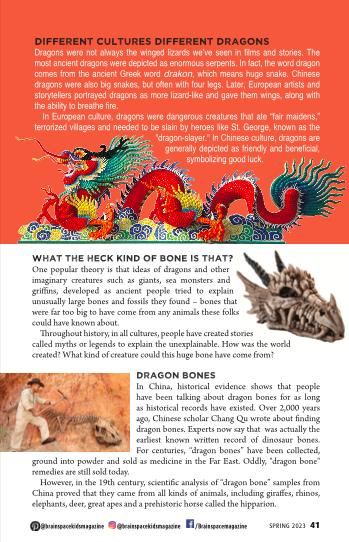
Dragons were not always the winged lizards we’ve seen in films and stories. The most ancient dragons were depicted as enormous serpents. In fact, the word dragon comes from the ancient Greek word drakon, which means huge snake. Chinese dragons were also big snakes, but often with four legs. Later, European artists and storytellers portrayed dragons as more lizard-like and gave them wings, along with the ability to breathe fire.
In European culture, dragons were dangerous creatures that ate “fair maidens,” terrorized villages and needed to be slain by heroes like St. George, known as the “dragon-slayer.” In Chinese culture, dragons are generally depicted as friendly and beneficial, symbolizing good luck.
.
WHAT THE HECK KIND OF BONE IS THAT?
One popular theory is that ideas of dragons and other imaginary creatures such as giants, sea monsters and griffins, developed as ancient people tried to explain unusually large bones and fossils they found – bones that were far too big to have come from any animals these folks could have known about.
Throughout history, in all cultures, people have created stories called myths or legends to explain the unexplainable. How was the world created? What kind of creature could this huge bone have come from?
.
DRAGON BONES
In China, historical evidence shows that people have been talking about dragon bones for as long as historical records have existed. Over 2,000 years ago, Chinese scholar Chang Qu write about finding dragon bones. Experts now say that was actually the earliest known written record of dinosaur bones. For centuries, “dragon bones” have been collected, ground into powder and sold as medicine in the Far East. Oddly, “dragon bone” remedies are still sold today.
However, in the 19th century, scientific analysis of “dragon bone” samples from China proved that they came from all kinds of animals, including giraffes, rhinos, elephants, deer, great apes and a prehistoric horse called the hipparion.
.
THE DRAGON’S CAVE
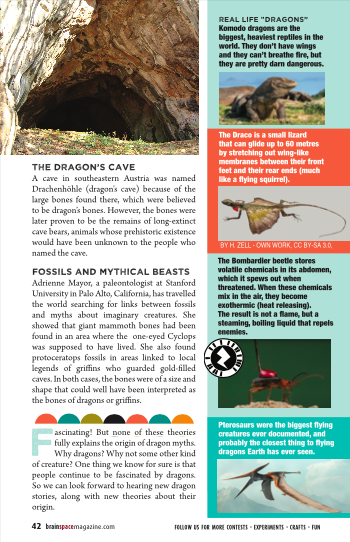
A cave in southeastern Austria was named Drachenhöhle (dragon’s cave) because of the large bones found there, which were believed to be dragon’s bones. However, the bones were later proven to be remains of long-extinct cave bears, animals whose prehistoric existence would have been unknown to the people who named the cave.
.
FOSSILS AND MYTHICAL BEASTS
Adreinne Mayor, a pleontologist at Stanford University in Palo Alto, California, had travelled the world searching for links between fossils and myths about imaginary creatures. She showed that giant mammoth bones had been found in an area where the one-eyed Cyclops was supposed to have lived. She also found protoceratops fossils in areas linked to local legends of griffins who guarded gold-filled caves. In both cases, the bones were of a size and shape that could well have been interpreted as the bones of dragons or griffins.
.
Fascinating! But none of these theories fully explains the origin of dragon myths. Why dragons? Why not some other kind of creature? One thing we know for sure is that people continue to be fascinated by dragon stories, along with new theories about their origin.
Scan the image below using the Zappar app to watch the video!